Gliding Through Bhutan’s Sacred Valleys: A Serene River Journey into Culture
November 18, 2025
Updated March 27, 2026
Estimated Reading Time: 12~14 min
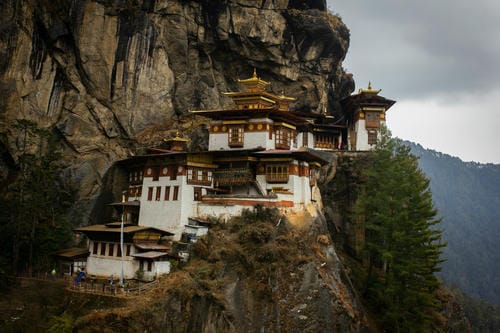
There’s a quiet magic that fills the valleys of the Himalayan kingdom of Bhutan—remote places where rivers carve silent paths between the ridges, tradition still holds sway in day-to-day life, and the traveler finds both beauty and introspection in equal measure. In this seldom-visited terrain, the journey by canoe or drift boat down one of Bhutan’s calm but potent waterways becomes more than an adventure: it becomes a passage into a world where nature, culture and ritual intertwine in subtler ways. In the wide sweep of a valley, amid forests and farms, you meet the roots of a land and the rhythm of life that most outsiders never sense.
In Western Bhutan around the valleys of the Punakha Valley and the confluences of the Mo Chhu and Pho Chhu rivers, it is possible to paddle or drift along routes that thread between rice-fields, farmhouses, chortens, and the great wooden fortress-monasteries that mark the cultural heart of the country. While most visitors stick to the familiar circuits of the capital Thimphu and the gateway valley of Paro Valley, those who venture into the lesser-travelled valleys by the water’s edge find a stillness and a depth of experience that lingers.
The river-route allows you to feel the land in motion—gliding past ancient farm walls, fluttering prayer flags, moss-covered chortens, and forest fringe that leads the eye up to high ridges and snow-glazed peaks. At the same time the cultural life of Bhutan flows alongside: small villages where children wave as your boat passes, monks chanting inside a dzong’s courtyard, farmers pausing fieldwork to gaze at the current. The journey becomes less about conquering rapids or ticking sights and more about listening to the whispers of the valley—its flowing water, its ancestral work, its quiet rituals.
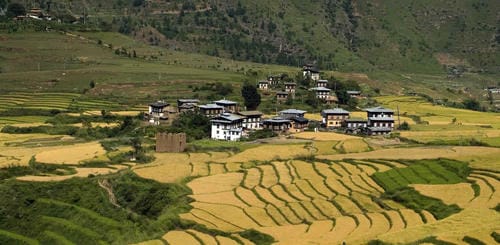
During this kind of trip you sense how rivers in Bhutan are not just physical features, but lifelines of community, culture, and ecology. Many of Bhutan’s rivers — including the Mo Chhu and Pho Chhu — rise high in remote glaciated zones and wind down through narrow gorges into broad fertile valleys. The Mo Chhu, for instance, rises in Gasa district near Bhutan’s northern border and flows south to meet the Pho Chhu in the Punakha Valley. [1] At the confluence the two waters mingle beneath the imposing fortress-monastery of Punakha Dzong, reminding you that nature and spiritual life are bound together here.
Villages cluster on terraces carved into hillside slopes. Farmhouses are built of wood and stone, with vivid painted windows and sloped roofs designed for winter snows. This is a region where identity is not just regional or national—it is deeply tied to place, to ridge and river, to root and ritual.
Roots of Culture and Ritual Along Quiet Currents
In Bhutan the valleys are not just scenic—they are cultural repositories where centuries-old traditions still shape daily life. When you drift down a river valley in Bhutan, you’re also moving through layers of ritual and heritage, visible in architecture, agriculture, village life and even in the flow of the water itself.
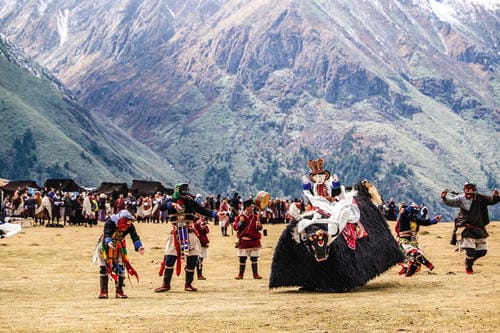
Take the valley of Punakha for example. The Punakha Dzong sits majestically over the confluence of rivers, as if guarding both the spiritual and physical heart of the region. The Dzong historically served as winter residence for the central monastic body of Bhutan. The fields below the fortress are tended in rotation by villagers, whose work is still shaped by the monastic calendar, by seasonal rites, by festivals (tshechu) where communities gather to witness masked dances and hear ancient tales. One can glide past these fields and feel that rhythm of human and natural time.
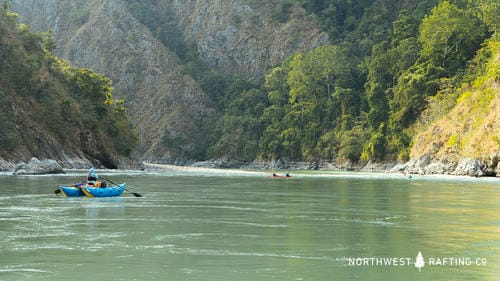
(Image from Northwest Rafting Company, the copyright belongs to the original author)
When you pause under a tree by the water, you may watch farmers haul irrigation water from a side‐stream, or village children skip stones across the river, or monks gather at the banks for a blessing. In Bhutan, many ritual events are tied to water and the valley: new year festivals begin with a river-washing ceremony; chorten-bells ring as smoke wafts over fields; bridges over strong currents become pilgrimage routes. The water is both functional and symbolic.
Because you are accessing the valley from the river, you see the settlement pattern differently. Houses face the river or the field, terraces step down toward water, stupa-walls are built along ridges overlooking the channel, and sometimes a simple wooden boat ferry still crosses a remote stream in lieu of a bridge. You begin to understand how water in these remote valleys is a connector—between villages, between ridges, between past and present.
During your journey, the river may whisper geology and ecology too. The glaciated ridges upstream, the forested slopes, the narrow gorges and wider valley floors tell a story of how land was shaped. For instance, the Pho Chhu and Mo Chhu rivers surge in spring from snow-melt and glacier melt, then soften in summer as they reach the valley floor. [2] In doing so they have carved the valleys, fed the irrigation canals, and defined where people could settle, farm, worship and live.
Engaging with the valley by river allows you to appreciate this natural heritage intimately. You may notice how one bend in the river has an old bridge, how a tiny temple clings to a riverside cliff, how fields snake into the hillsides in patterns dictated by the slope and by water flow, and how rituals—annual ploughing, seed orthodoxy, blessing of the valley—are all timed to the river’s moods.
Practicalities and Immersive Tips
When planning your journey into such a valley by river in Bhutan, several practical considerations ensure the experience remains immersive, respectful and meaningful rather than purely touristic. Here are some key insights to keep in mind.
Timing and river condition:
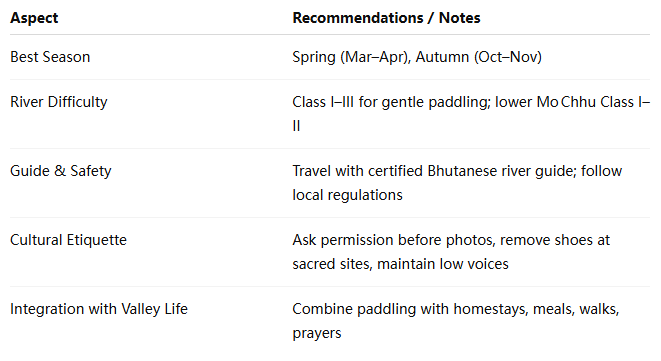
The rivers of Bhutan flow from mountain sources and are highly seasonal. Spring (March-April) and autumn (October-November) are generally the optimal times for river excursions because currents are moderate, weather is stable, and skies are clear. In the valley, you’ll feel the early warmth of spring bloom in terraced fields or see trees turning colour before winter sets in. For slower, more contemplative paddles, choose stretches that are classified as easier (Class I–III) rather than full white-water rapids.
Choosing your stretch:
If you prefer a gentle drift through valley calm rather than an adrenaline-run, pick a lower-gradient stretch near the valley floor—where the river is wider, slower, and bordered by farmland and villages. This lets you focus on scenery, ritual moments and cultural immersion rather than navigating rapids alone. One route that has guided options is along the lower Mo Chhu in the Punakha Valley, where difficulty can be Class I–II.
Local guide, permission and respect:
Because you will be entering remote valley areas, it’s important to travel with a local Bhutanese guide who understands river safety, valley access, cultural protocols and the rhythms of village life. The country regulates river rafting and kayaking closely, with trained river-guides and safety standards. You’ll also want to engage respectfully: ask permission before photographing villagers, learn about local temple or chorten etiquette, remove shoes when required, and maintain silence or low voices when floating past sacred sites or monastery grounds.
Integration with valley life:
Rather than treating the river ride as a standalone activity, integrate it with valley stays, village homestays, local meals and walking the banks. After the paddle, walk through a nearby village, share tea with a farmer, join in a late-afternoon prayer ceremony, or stay overnight in a lodge overlooking the river. This multiplies the impact: the movement through water becomes part of a full-valley experience. The settling in-moment of being riverside at dusk, listening to the forest and village life, is just as important.
Post by Isabella Moreno
Sources:
[1]: https://www.raonline.ch/pages/bt/visin/btdestin01b.html
[2]: https://www.drukasia.com/bhutan/punakha/white-water-rafting-in-bhutan
References:
https://www.raonline.ch/pages/bt/visin/bt_country02a.html
https://www.bhutanhappiness.com/through-the-rivers
Keep your wanderlust going—explore more articles filled with adventures, travel hacks, and destination ideas!