Surfing Kathmandu’s Urban Rapids in the Shadow of the Himalayas
November 16, 2025
Updated March 27, 2026
Estimated Reading Time: 12~14 min
When the notion of surfing enters your mind, you likely imagine tropical beaches, rolling ocean waves and salty spray. But what if the surfboard found a new venue—an urban river in the heart of the Himalayas? Welcome to Kathmandu, Nepal: a city of ancient temples and bustling markets, where the rivers that flow through its basins beckon those craving a different kind of ride.
The valley of Kathmandu is bisected by the Bagmati River, which — although far from Paris Hilton-beach-style surfing — offers a surprising twist on board-balance fun. Although mainstream river surfing in Nepal is more commonly associated with gorges or managed rafting trips, the concept of riding standing waves or urban rapids has taken root here too. The sport of River surfing—in which surfers face upstream and ride a stationary wave formed by flowing water passing over a rock obstacle—provides the theoretical underpinning for such an unexpected adventure.
Setting Off: From City Streets to Flowing Currents
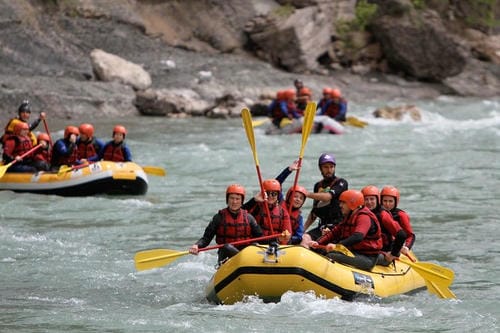
Your journey begins in the heart of Kathmandu’s valley, with a worldview shift: from ancient pagodas and rickshaw-loads of people to the white-water energy of mountain rivers. The most renowned river to boat or raft from Kathmandu is the Trishuli River, accessible via the Prithvi Highway and offering Class II–III rapids for day trips. [1] Even though Trishuli is geared toward rafting, the fact it’s described as “one of the closest white-water rafting destinations from Kathmandu” signals the region’s accessibility if you’re chasing river-action. [1]
But here’s where surfing in an urban context comes into play. Near Kathmandu’s city-scape, the Bagmati and nearby tributaries carry flow through terraces, rock formations and urban obstacles. The key condition for standing-wave surfing is present: flowing water over a constriction or rock creates a stationary wave—something you might normally only expect in floodplains or dedicated artificial waves.
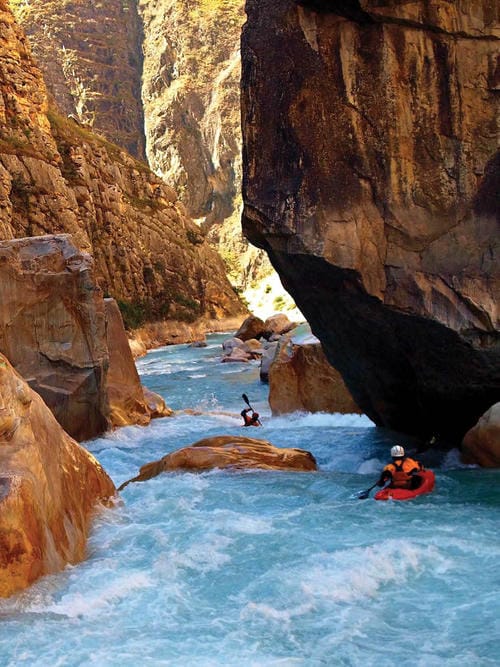
One article intriguingly points out that within Kathmandu’s valley, “this city offers a surprisingly vibrant surfing culture” — despite the obvious lack of ocean swells. [2] That culture shift—from board shorts to helmet, from sea to stream—sets the tone.
A typical itinerary? You might rise in Kathmandu, drive toward a put-in point (either a near-city section of the Bagmati or a short drive out to Trishuli or a similar nearby river), receive a safety briefing, don a helmet and life jacket, carry or strap on a board suited for river surfing (often shorter, stouter, with a leash), and then step into the current. You’ll face upstream, drop into the line, and—if conditions are right—ride the stationary wave, balancing against the flow rather than chasing an ocean swell. The payoff: a surreal moment of surf-flow in a landlocked, high-Himalayan valley.
The best season for such adventures tends to be post-monsoon into autumn, when flow is robust but not dangerously high. For rafting in Nepal, guides suggest that the high-water season is summer to early fall (June-November), while spring and winter offer gentler flows but still viable trips. [1] That means if you time it right, you might hit the sweet spot: enough volume for a standing wave, but not so much that you’re swept away.
The Ride: What It’s Like and What to Know
Picture this: you’re kneeling or standing on a board in a flow of crystal-fresh Himalayan water, helmet on, board leash clipped in, the roar of the river echoing off the valley walls of Kathmandu’s rim. You’ve picked your line: the water bulges upstream of a rock altar, currents colliding to form a standing face of water that holds you in place if you balance. You lean forward, feel the lift, the drag, the surf sensation—but you’re essentially staying in one spot, viewing the world sliding downstream behind you. This is river surfing’s magic—particularly in its standing-wave form.
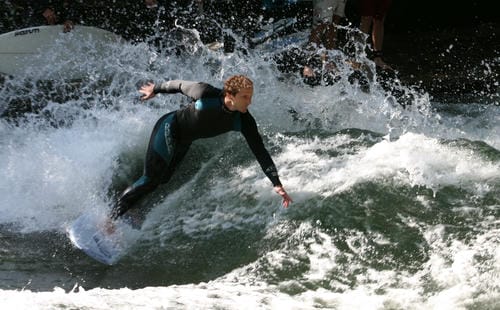
Board and gear: River-surf boards tend to differ from ocean longboards. They need more rocker or planing surface to respond to the shorter, sharper wave, and often have reinforced edges to deal with rocks or debris. A leash is critical (but may have extra breakaway features). You’ll want a helmet and personal flotation device (PFD), as the urban and mountainous context introduces hazards.
Wave selection: The standing wave forms where the river flow is constricted—rock ledge, drop‐off, narrowing channel—and where the Froude number (a ratio of flow speed to gravity) becomes high enough. The wave face remains stationary relative to the riverbed, allowing you to ride it. In Kathmandu’s rivers, look for those zones where urban stone walls or natural rock force the current into a tight face.
Environmental conditions: Flow levels matter. If the volume is too low, the wave is weak or non-existent; too high, and it may become unsafe or broken. In Nepal, the monsoon and post‐monsoon flows define the window of opportunity for such rides.
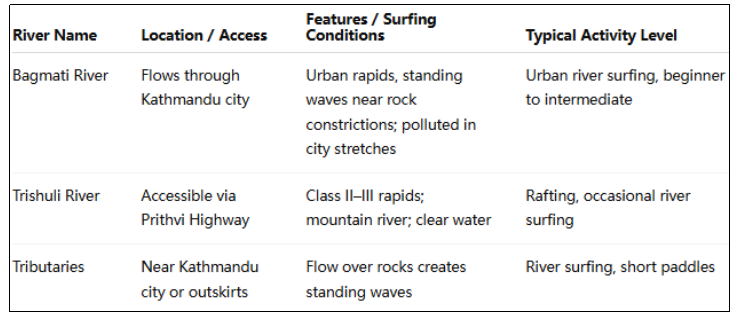
Safety and logistics: Unlike ocean surfing, river surfing in an urban context introduces unique hazards: cold water (depending on elevation), submerged rocks, urban debris, possibly polluted tributaries in city zones. For instance, the Bagmati is known to be heavily polluted as it passes through Kathmandu city limits.
The ride itself: You drop in facing upstream, paddle hard for the first moment (or get positioned by a guide or current help), then lean back to stay on the wave’s crest. Your board hovers while the surroundings flow past—you’re surfing and standing still at once. When you’re ready, you’ll let go, ski down the wave’s lip or step off sideways and float away.
After the wave: Once you’re done, you’ll likely paddle or float downstream to a take-out point, rinse off if possible, gear up, possibly share a riverside snack. In a place like Kathmandu, you might then return to urban life—chai, temple visits, souvenir shopping—after an hour of hydro-adrenaline.
In terms of the experience, it’s less about popping huge air or carving long walls (as with ocean breaks) and more about mastering balance, reading current, feeling water energy and the surreal environmental context. Imagine watching an urban temple stick above the river banks, hearing chanting or horns in the city, while you ride a wave in a Himalayan side-valley. That’s the charm.
For novices, partnering with a local operator or guide is wise (especially given urban river hazards and variable flow). The general Nepal rafting guide indicates that rafting companies can provide decent logistic support and safety measures for river use.
Why this is compelling for the travel-blogger and surfer alike?
From a travel-blog perspective, this blend of culture + adrenaline + urban nature ticks boxes that excite readers. On one hand you’re in Kathmandu, absorbing ancient architecture, daily life in a Nepali metropolis. On the other, you’re standing on a surfboard in a Himalayan stream, riding a wave that didn’t need an ocean. It’s visually arresting, narratively rich, and offers that “unexpected adventure” angle.
For surfers or board-enthusiasts, it’s the lure of the unusual: a standing wave in a river, in a landlocked country, in a valley surrounded by peaks. It shifts the paradigm from beach to mountain, from tide to flow, from salt spray to river mist.
Post by Ethan Brooks
(Travel involves risks. The author is not responsible for any injuries, losses, or damages that may occur while following advice, itineraries, or suggestions provided on this blog. Always exercise caution and follow local rules.)
Sources:
[1]: https://nepalecoadventure.com/trip/1-day-trisuli-river-rafting
[2]: https://piedalies.lv/en/article/id/64167/discover-the-unexpected-surfing-destinations-in-kathmandu
References:
https: //www.gonomad.com/155238-running-the-wild-rivers-of-nepal
https ://www.roughguides.com/nepal/rafting-and-kayaking
Keep your wanderlust going—explore more articles filled with adventures, travel hacks, and destination ideas!