Marostica’s Marble Board: Where Strategy Meets Medieval Splendor
November 19, 2025
(Image from Lineasette, the copyright belongs to the original author)
Updated March 24, 2026
Estimated Reading Time: 8~10 min
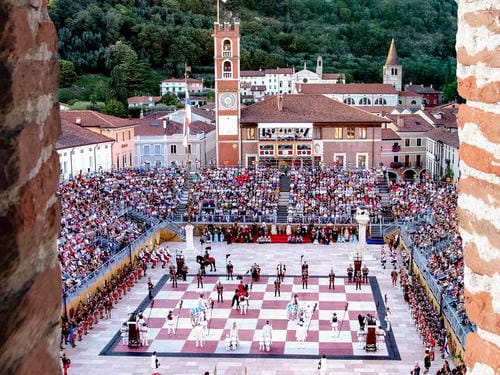
You arrive in Marostica—the little town perched on the foothills of the Veneto plain—and one thing strikes you immediately: right in the town’s heart lies a chess-board, not merely drawn or painted, but etched onto the very paving of the square. The shimmering checkerboard stands out within the medieval walls, and you know at once that this is a place where strategy meets spectacle. Marostica’s claim to fame is its biennial “living chess” spectacle—people in full heraldic regalia move as knights, bishops, rooks on giant squares in the main piazza. [1]
But the chessboard is just the beginning. Beyond that square you discover ramparts climbing olive-groved slopes, twin castles (one above the town, one in the square), medieval walls circling the settlement, and churches and palazzi that whisper of Venetian dominion and centuries of layered history.
The journey into Marostica is a journey into layered narratives: the game of kings played out in public squares, the strategic importance of town walls and castles, and the ritualised pageants of medieval legend. For the traveller, this is a chance to pause—not in bustling cities or in the shadow of grand cathedrals—but in a micro-town where many threads meet: play and power, legend and landscape, past and present.
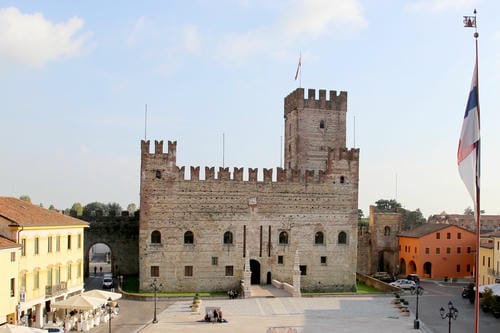
Walking from the gates of the Lower Castle into the piazza, the chessboard underfoot seems to invite participation: the game, after all, is real in its roots. According to legend, two knights vied for the hand of the lord’s daughter in 1454, and the duel was replaced by this grand chess match in the town square. [2]
You might wander the town in a quiet hour, long after the crowds have gone, and the board lies undisturbed beneath your feet. Then you scale the stone stairway, winding along ancient battlements to the Upper Castle ruin. From the crenellated ramparts you look back down across the piazza—white and pink stone squares reflecting the golden light—and farther still across the Veneto plain, the horizon of flatlands giving way to green hills and the silhouettes of the Pre-Alps.
Cathedrals, Walls & Stone-Echoed Devotion
After the square and the chessboard, turn your attention to the quieter but no less compelling aspects of Marostica: its walls, its churches, its carved stones echoing centuries of devotion, defense and local craft. The town is embraced by a continuous ring of walls built in the 14th century, with 24 towers wrapping the hill and connecting the Lower and Upper Castles.
These ramparts weren’t built to decorate—they were built for war. They stand as a reminder that Marostica, though charming now, once occupied a strategic niche where rival powers fought for control of the Veneto region. As you trace the path of the ancient walkways, you may still sense the weight of countless stones, the flicker of torchlight in a guard’s watchtower, the clang of armour on the rampart walk.
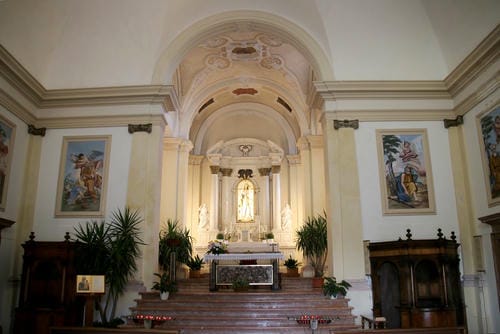
Nestled within these walls are sacred spaces that reflect the faith and artistry of generations. Wander into the town’s churches—some modest, some adorned—and you’ll find that they carry the imprint of eras: from Venetian-Gothic facades to baroque altars to simple chapels shading paths up to the castle. One such route—via via Beato Lorenzino, rising from the ancient settlement of Borgo Giara—winds past the Church of San Gottardo (1470) and on toward the Upper Castle, intertwining faith, hillside, history.
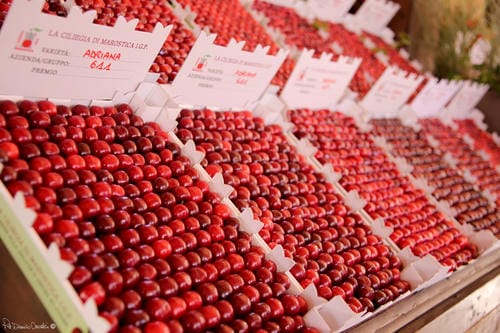
And yet it’s not only stone and prayer that define Marostica—there is a local craft, a quiet ritual of harvest: the cherry collects. The town is renowned for its cherries, the Marostica Cherry bearing a PGI mark, and every spring the hillsides blush with trees heavy with fruit. Picture yourself lingering after mid-morning strolls, sipping espresso by the piazza, the aroma of baked cherry-cakes drifting in the air, the ancient stones of church and wall around you framed by spring green or autumn gold.
Venturing beyond the town’s heart, you find winding foot-paths cutting through olive groves and chestnut woods, leading you to the viewpoints from which stone, wall and roof-tile form the silhouette of medieval life. One route leads you from the walled city to the top of Monte Pausolino, offering 360-degree panoramas of the Veneto plain, the Colli Berici, the Asiago plateau, and the distant Dolomites. The walk itself is a meditation: the crunch of gravel underfoot, the whisper of wind in the trees, the stone stair rising through centuries. [4]
Marostica rewards the traveller who slows down: who explores the square without an agenda, who sits in the shade of the portico, who climbs the wall-path at golden hour, and pauses at the church steps as bells echo between the towers. This is travel of the sensorial kind—where the smell of cherry blossom, the touch of worn stones, the soft clang of a distant festivity all become part of the experience.
And when you find yourself back in the piazza at dusk, with lights just alight on the chessboard paving and shadows stretching along the ramparts, you’ll know you are in a place where strategy doesn’t just play on wood and ivory—it plays in stone and air and light.
Planning Your Visit and Immersion
Visiting Marostica is both straightforward and inviting—but planning your timing and pace will elevate the experience. The town lies in the province of Vicenza in northern Italy, and though close to major centres like Venice and Verona, it retains a quiet, intimate air.
Timing and Events:
If you visit in the spring, you may catch the cherry bloom and the early markets celebrating the local cherry harvest. The Marostica Cherry has earned PGI status, and you’ll find local cafes offering cherry-cakes, cherry jams, and the crimson fruit itself.
If you’ve come for the spectacle, mark your calendar: the “living chess” event in Piazza Castello takes place every even-numbered year on the second weekend in September. Please note: if you arrive in an odd year, you’ll still enjoy the setting and the square, but the full living-chess pageant will not be staged.
Getting Around & Pace:
Take comfortable walking shoes—the town is compact, cobbled, and you’ll want to explore on foot. Begin in the town square, wander into the old-town streets, climb to the castle walls, pause in the cafés underneath porticos. One recommended walking route leads you from the medieval village to the walled city along the “Route 1” path, about 4 km and 150 metres elevation gain, weaving through ancient streets, churches, olive groves.
Accommodation & Atmosphere:
Because Marostica is small and historic, staying overnight gives you an atmospheric advantage—early morning light on the chessboard paving, quiet streets before tour groups arrive, a chance to enjoy the town when others have gone on. There are charming B&Bs within the historic walls and up on the hillside near the Upper Castle with panoramic views.
Marostica offers a rare layering: a medieval fortified town, perched between plain and hills; a living tradition of every-two-year human chess; a local agricultural identity (cherries); and an architecture of stone, walls, towers, square. Unlike grand cities with soaring cathedrals and huge crowds, here you find scale you can absorb: you can stand on the ramparts and see the chessboard, rooftops and hills all in one frame. And when you descend, you are still in the piazza where just hours before or just hours later you might join a dozen locals over espresso, the paving still bearing the imprint of kings and pawns.
Post by Isabella Moreno
(Travel involves risks. The author is not responsible for any injuries, losses, or damages that may occur while following advice, itineraries, or suggestions provided on this blog. Always exercise caution and follow local rules.)
Soureces:
[1]: https://www.italyheaven.co.uk/veneto/marostica
[2]: https://www.italia.it/veneto/marostica
[3]: https://audiala.com/italy/marostica
[4]: https://www.veneto-explorer.com/medieval-towns-and-villages_marostica.html
References:
https://www.visitmarostica.eu/en/to-visit/routes/medieval-village-walled-city
https://nextstop-italy.com/charming-villages/cittadella-marostica-walking-history
https://www.tourissimo.travel/blog/marostica-the-city-of-chess
Love discovering new places? There’s plenty more waiting for you here. From scenic escapes to off-the-beaten-path adventures, our blog is your passport to endless inspiration. Keep scrolling, and let your curiosity wander!