Echoes of Stone: Walking Through Bosnia’s Secret Walled Towns
November 21, 2025
Estimated Reading Time: 12~14 min
Bosnia and Herzegovina is often heralded for its natural beauty, its rivers, canyons, and mountains. Yet tucked between those landscapes lie ancient towns whose walls speak louder than any guidebook. These hidden medieval and Ottoman-era strongholds seem to whisper secrets of past empires, defiance, and quiet resilience. To walk along their ramparts is to trace the footsteps of kings, soldiers, and villagers whose lives and architecture wove together centuries of complex history.
Hidden Fortresses Among Hills and Rivers
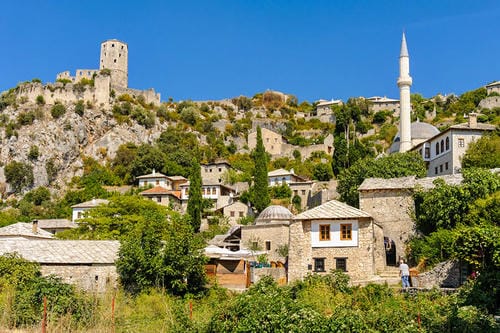
A journey through Bosnia’s lesser-known walled towns begins with Počitelj, a village perched on rugged limestone cliffs overlooking the emerald stretch of the Neretva River. The first documented mention of Počitelj dates back to 1444, though its origins likely reach deeper into the medieval Bosnian state. Its fortified stone ramparts evolved in two distinct architectural stages — the mediaeval and the Ottoman — framing a spatially self-contained town that remains remarkably coherent in its design.
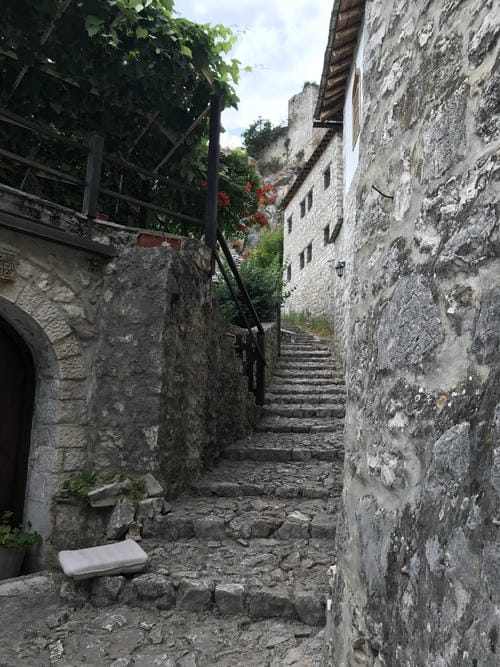
Walking Počitelj’s cobbled alleys feels like stepping through a portal: Ottoman-style houses with red tile roofs cling to the hillside, while a slim minaret from the 16th-century Hajji Alija Mosque rises into the sky. The town’s defensive walls echo the rocky slope below, curving with the terrain to create natural fortifications against both river and mountain. Počitelj isn’t merely a preserved ruin — it's a living village, with about twenty families maintaining these stone homes as their own, generation after generation. [1]
Not far away lies Stolac, or more precisely, the old walled town of Vidoški, situated high above the modern town. The fortified town was first mentioned in the mid-15th century, and over time its walls witnessed a succession of ruling powers — from the medieval Bosnian state to the Ottomans, and later Austro-Hungarian authorities. The ramparts here are not simply fortifications; they guard nine historical layers — from prehistoric Illyrian times through Roman, medieval, Ottoman, and Austro-Hungarian eras.
These walls rise above the town in limestone, sculpted by centuries of conflict and continuity. They frame narrow streets, stone dwellings, and places of worship interwoven with each other — a testament to the layered soul of Stolac. Walking them, you feel both the weight of history and the lightness of the sky meeting that history on rock.
Citadels, Castles, and the Silent Voices of Strongholds
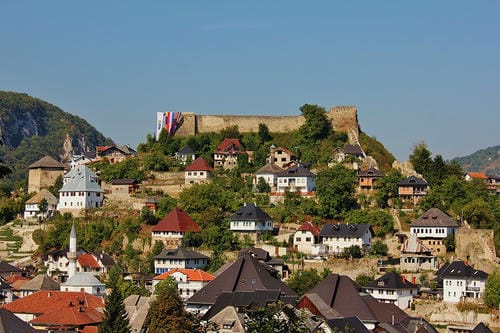
Beyond Počitelj and Stolac, Bosnia holds other architectural treasures whose fortifications silently narrate long-gone chapters of power and defense. In Jajce, one encounters the imposing citadel that crowns the town. Built in the 14th century, the Jajce Fortress defines the skyline, while its ramparts wrap around the walled city like a protective embrace. The fortress walls stretch to the Pliva River, turning sharply to navigate the terrain — a living map of the town’s medieval defense strategy.
(Image from visit-herzegobvina.co.uk, the copyright belongs to the original author)
High above the town, walkways along the citadel’s ramparts reveal sweeping vistas of Jajce’s red-roofed houses, religious buildings, and winding streets down below. From here, the scenery is framed as though by an ancient window, letting you see how nature and human ambition once joined to build a stronghold that was both fortress and home.
Further southeast, Klobuk Fortress near Trebinje tells a different story. This structure has remained since before the 10th century, its walls built by successive powers who recognized its strategic value on the karst plateau of Mirotinske grede. The silhouette of Klobuk is austere: strong stone walls, slopes of limestone, and a sense that the fortress once watched over trade routes and defended borders. Today, parts of the structure lie in ruins, but even in that silence, the ramparts still hold memories of medieval lords and Ottoman administrators.
In the rugged terrain near Gacko stands the old Ključ Castle, a fortress complex whose walls rise from limestone ridges with formidable presence. The fortress includes both an upper town and a lower town, connected by fortified passages. The outer rampart of the upper town is particularly striking: about seven meters high, unusually wide, and built to withstand both medieval warfare and Ottoman firearms. Tracing the paths of these walls, you might come across cannon openings, secret exits, and dungeons — the architecture offers more than mere views; it reveals layered strategy and resilience.
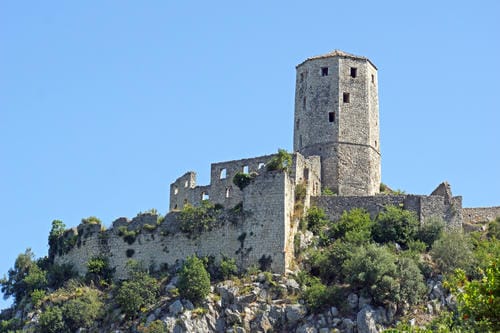
Then there is Kaštela Fortress, tucked into the cliffs of Mount Zahor near Fojnica. Suspended high above a steep canyon, Kaštela’s design is unique: caves built into the cliff face serve as chambers, while the fortress itself functioned as both monastery and stronghold during the medieval Bosnian state. The stones speak of spiritual refuge and military vigilance, of faith carved into rock, and faith defended with ramparts. Though the structure is fragile today, its wooden beams and twin towers still defy gravity and time.
The Traveler’s Quiet Path: Why Walk These Walls
To walk the ancient walls of Bosnia’s hidden towns is to move through time. Each stone underfoot is a page of history, and every turn of the wall gives you a new vantage — of rivers, hills, valleys, and villages that survived empires. As you trace the ramparts of Počitelj, you sense not just military strength, but a community that watched the Neretva flow by for centuries. On the battlements of Jajce, you glimpse a town that was once a royal seat and saw both medieval rule and Ottoman expansion. In Ključ and Klobuk, the rock itself seems to guard stories of defense, retreat, and legacy.
These walls are not just tourist attractions; they are living monuments. In Počitelj, for instance, people still live in the very houses that the ramparts protect. [1] That continuity gives visiting a certain humbling intimacy. You aren’t simply observing relics — you are stepping into spaces where life still pulses under ancient stone.
Bibliophiles, architecture lovers, history seekers, and slow travelers will find deep reward in these towns. Unlike the busier cities, hidden towns like Stolac, Počitelj, Ključ, and Jajce offer room for quiet reflection. To traverse their ramparts is to tune into quieter frequencies: whispers of past rulers, echoes of ancient trade routes, and the steady pulse of stones shaped by time.
(Travel involves risks. The author is not responsible for any injuries, losses, or damages that may occur while following advice, itineraries, or suggestions provided on this blog. Always exercise caution and follow local rules.)
About the Author:
Sophie Henderson is a certified travel health advisor and journalist with a decade of experience reporting on wellness travel. She focuses on sustainable destinations, local cuisines, and experiences that promote mental and physical well-being.
Sources:
[1] https://www.le-journal-catalan.com/en/this-ottoman-fortress-village-clings-to-limestone-cliffs-above-a-turquoise-river-and-most-travelers-have-no-idea-it-exists
Keep scrolling—your next favorite destination might be just ahead!